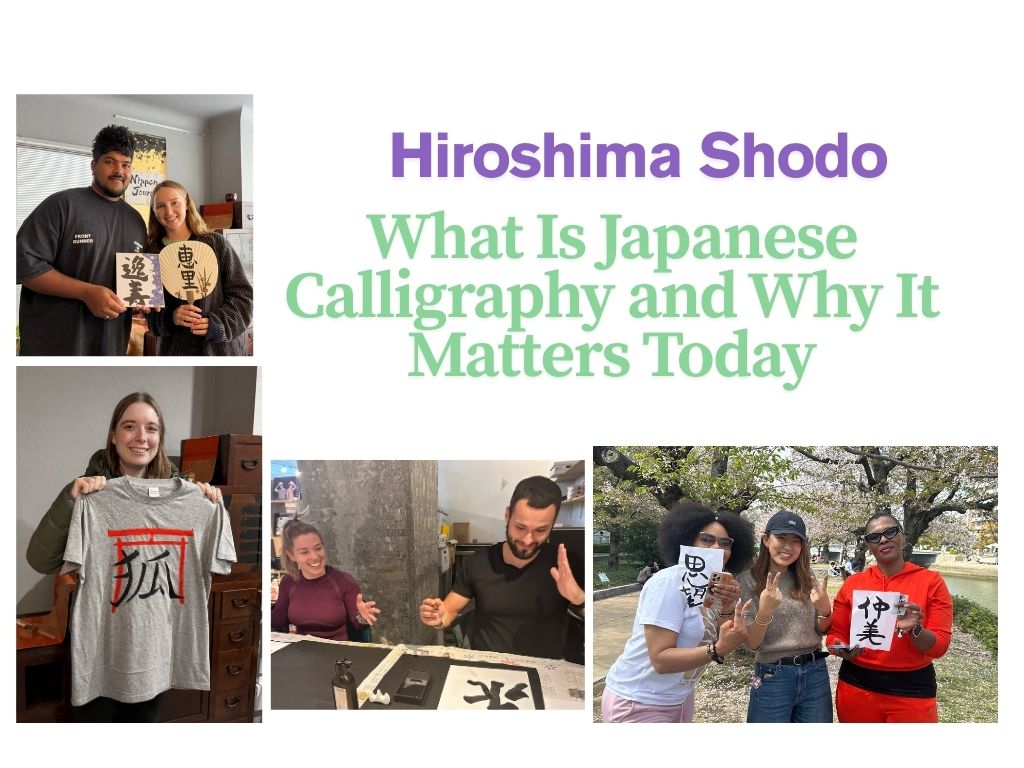
When people hear the word calligraphy, they often imagine beautiful letters written with a brush.
But Shodo, Japanese calligraphy, is more than just writing characters.
It reflects the history of the Japanese language, the influence of Buddhism, and the way Japanese people have expressed emotions for over 1,000 years.
In this article, I’ll introduce what Shodo is, how it developed, and why Hiroshima is a meaningful place to experience Japanese calligraphy today.
What Is Shodo? – Understanding Japanese Calligraphy
Shodo literally means “the way of writing.”
Like Tea Ceremony (Sado) or Martial Arts (Judo), Shodo is not only a skill, but a way to reflect the mind through movement.
In Japan, calligraphy is deeply connected to the history of the Japanese language itself.
To understand Shodo, we first need to understand how writing came to Japan.
The History of Shodo: How Japanese Writing Began
1. Japan Before Writing: The Yayoi Period (around 1st century)
Before written language arrived in Japan, people already had a spoken language.
They could say things like “Hello” or “It’s a beautiful day today.”
However, there was no writing system to record those words.
This situation is not unique to ancient Japan.
Even today, there are communities in the world that live without written language.
For example, the Pirahã people in the Amazon are known for having no words for numbers or colors.
Japan, too, once lived in a world where language existed only through sound.
2. The Arrival of Kanji from China
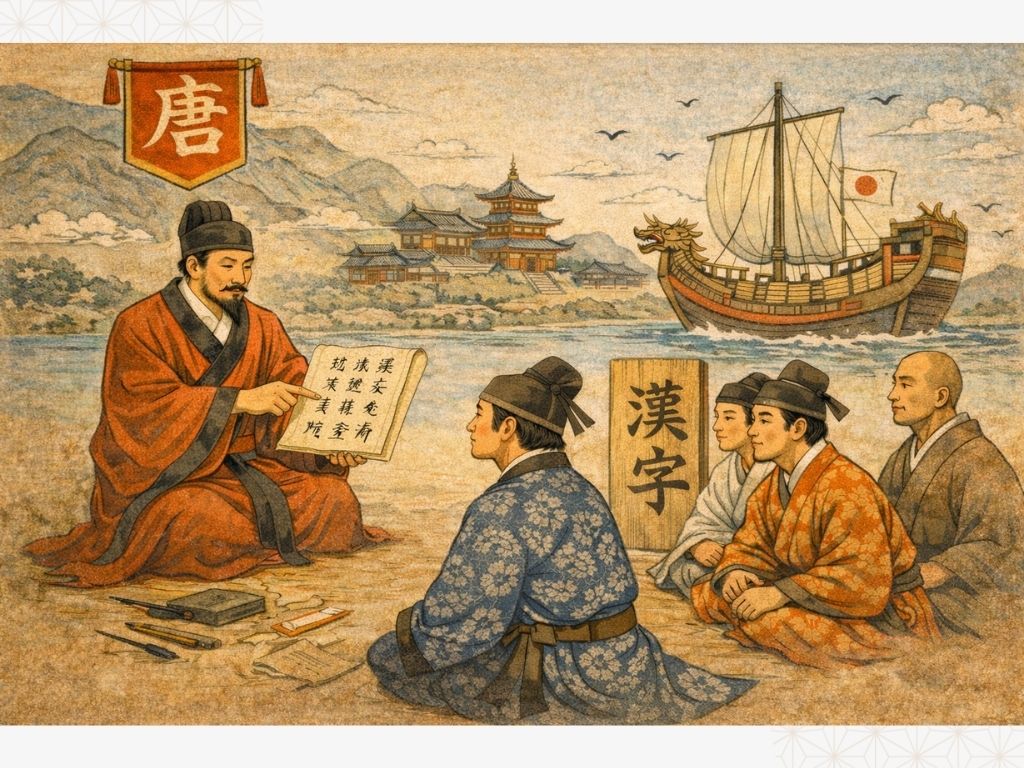
Chinese characters, known as Kanji, were introduced to Japan from China.
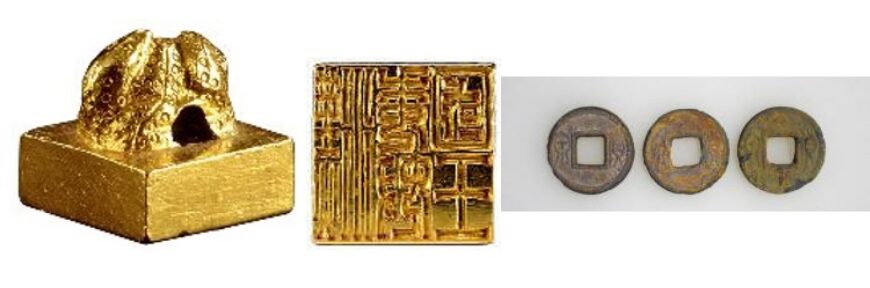
Archaeological discoveries such as gold seals and bronze coins show that Japan had contact with China.
One famous example is the gold seal engraved with
“King of Na of Wa, under the Han dynasty.”
Through these encounters, Japan realized that writing could be used as part of society.
At that time, China already had over 1,400 years of writing history.
Because China had a vast land and a large population, written language was essential for administration and governance.
Japan, however, did not yet feel the same need.
3. When Japanese People Began Writing (around 5th century)
Around the 5th century, iron swords and bronze mirrors with inscriptions were found in ancient tombs in Japan.
These writings recorded loyalty to Japanese rulers.
Because of their content, scholars believe they were written by Japanese people, not by Chinese scribes.
This marks the moment when Japanese people began using written characters themselves.
Even so, literacy was limited to a small elite.
Although Kanji had arrived centuries earlier, writing was still not part of everyday life.
4. Buddhism and the Birth of Shodo (7th–8th century)
In the 6th and 7th centuries, Buddhism, Confucianism, and Taoism were introduced from China.
As people wanted to study these teachings, the ability to read and understand written texts became important.
However, writing with a brush on paper did not become widespread until the late 7th century.
The turning point came during the Nara Period.
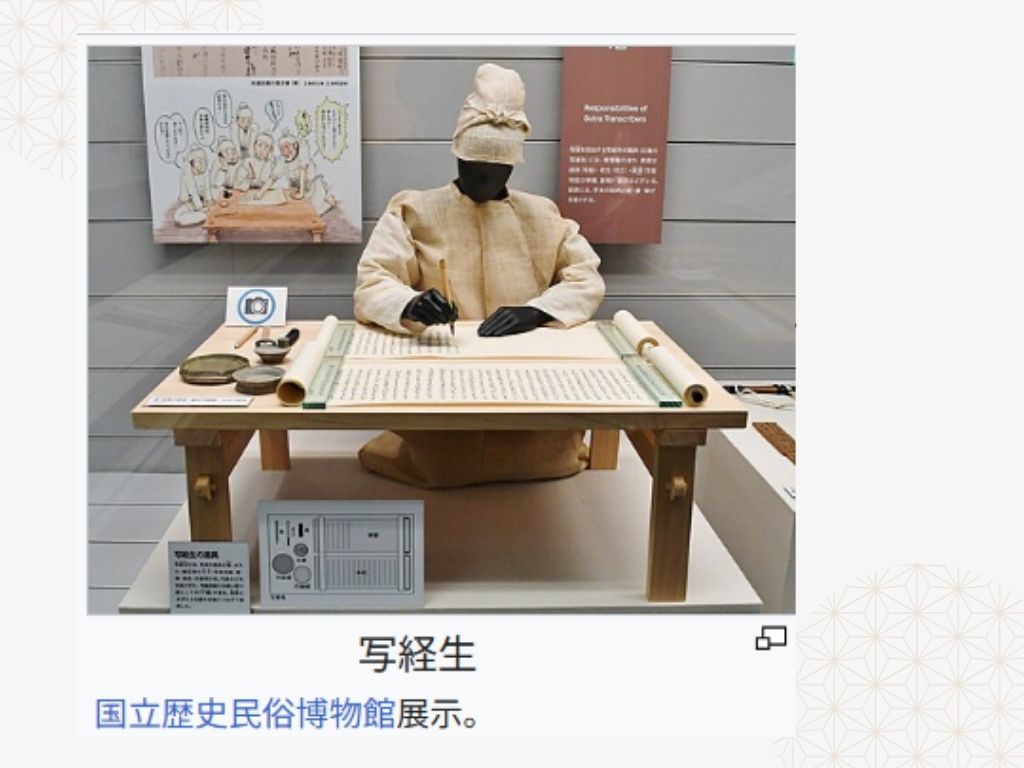
Emperor Shōmu promoted Buddhism as a national policy, and large-scale sutra copying projects were launched.
People called sutra copyists spent their days carefully copying Buddhist scriptures.
Through this process:
- Paper and brushes were mass-produced
- Writing techniques improved
- Shodo officially began as a cultural practice
Accuracy and consistency were valued above all else.
Characters were written evenly, with precise spacing and structure.
5. The Heian Period: The Golden Age of Japanese Calligraphy (9th century)
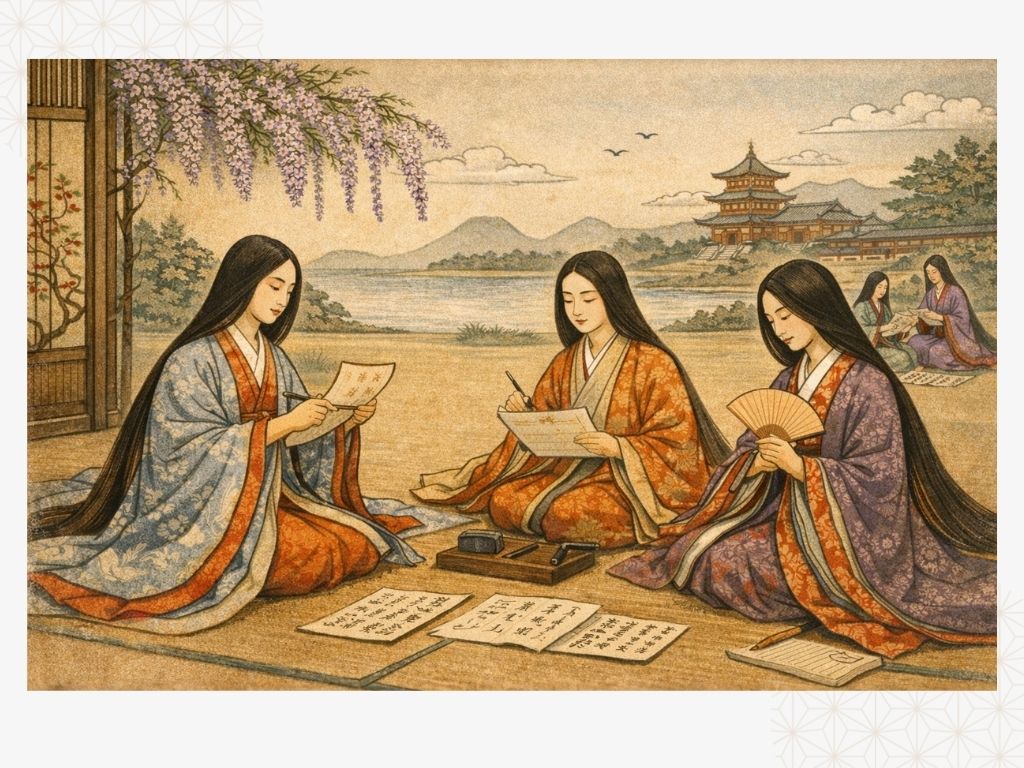
In the 9th century, during the Heian Period, Japan created something entirely new:
its own writing system.
This was the birth of Hiragana.
Hiragana did not appear suddenly.
It developed from Manyogana, a system that used Kanji purely for their sounds.
For example, Japanese emotional expressions such as
“~ne” or “~yo” could not be expressed naturally with Chinese grammar.
Japanese people often wondered:
“How do we write this feeling?”
By borrowing the sounds of Kanji, they finally found a way to write Japanese as it was spoken.
However, Manyogana required many complex characters and took a long time to write.
As aristocrats wrote letters and diaries daily, they gradually simplified the characters.
This process led to the creation of Hiragana.
With Hiragana, Japanese people established their own original written language for the first time.
6. The Birth of Japanese Shodo
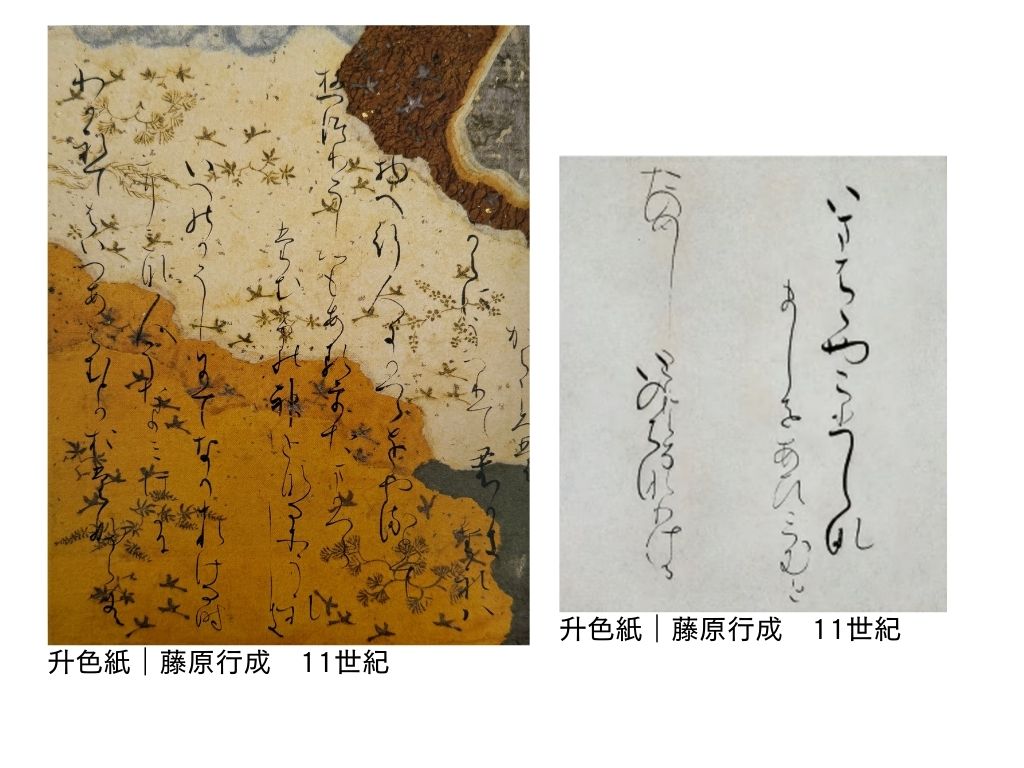
From the mid-Heian Period onward, Hiragana was appreciated for its beauty.
This style of calligraphy is known as Kana Shodo, which focuses on:
- Smooth brush movement
- Balance and spacing
- Ink density
- Bold use of empty space
- Decorative paper with gold and color
Unlike earlier sutra copying, calligraphy became a way to express emotion and aesthetics.
With the creation of Hiragana, Japanese Shodo was fully established.
Shodo Today: From Education to Art and Relaxation
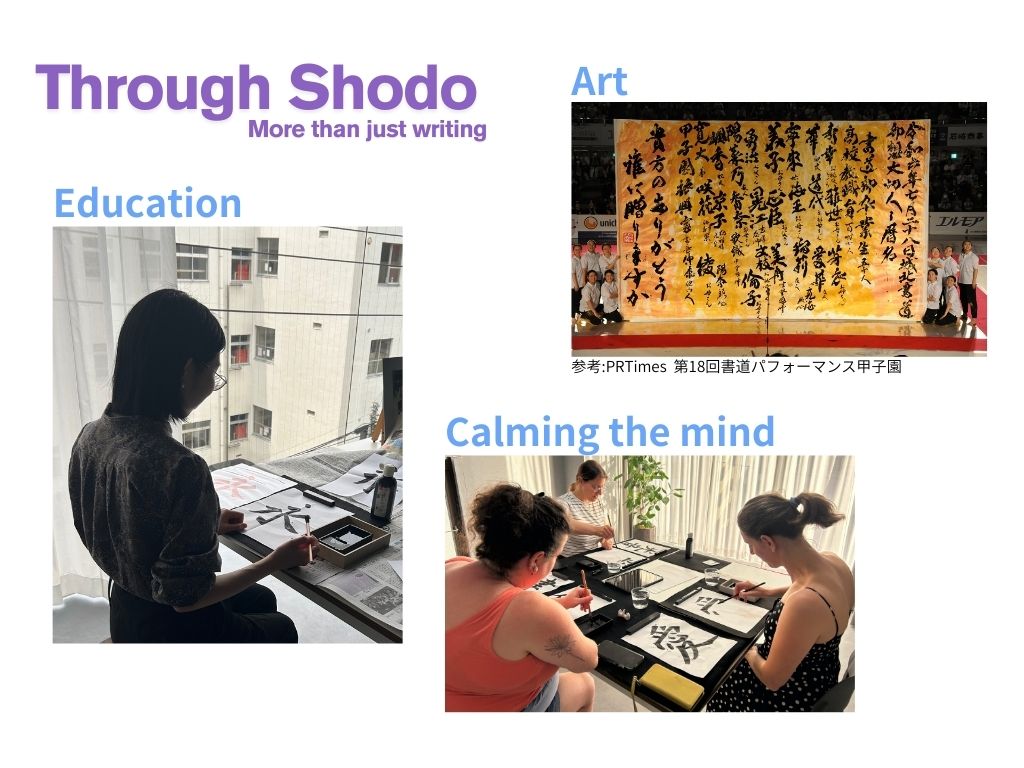
In modern Japan, Shodo is no longer mainly used to record information or copy texts.
Instead, it has evolved into a cultural practice that connects education, art, and relaxation.
Many Japanese people first encounter Shodo at school.
Calligraphy is part of formal education, where children learn not only how to write characters, but also how to sit properly, focus their attention, and move the brush with care.
Because of this, Shodo feels familiar and deeply rooted in everyday life rather than distant or ceremonial.
At the same time, Shodo has expanded beyond classrooms.
Calligraphy performances using large brushes and dynamic movements have become popular, and contemporary calligraphers explore abstract forms, modern design, and large-scale works.
Today, Shodo is recognized as a form of Japanese art that continues to evolve.
Another important role of Shodo in modern society is relaxation.
Writing with a brush requires slow movement, steady breathing, and full concentration on the present moment.
For many people, Shodo feels similar to meditation — there is no need to aim for perfection, and even mistakes become part of the expression.
This combination of education, art, and mindfulness is what makes Shodo unique today.
It is not only about writing beautiful characters, but about experiencing Japanese culture through the body and the mind.
For this reason, Shodo continues to attract people from all over the world who are looking for a meaningful and calming cultural experience.
Why Hiroshima Is a Special Place to Experience Shodo
Hiroshima is known worldwide as a city of peace.
Many visitors come here to learn about history, memory, and the importance of not repeating the past.
At the same time, visiting Hiroshima can be emotionally intense.
While the experience is meaningful, some people feel overwhelmed by the weight of what they see and learn.
This is where Shodo naturally belongs.
Shodo is a quiet practice.
It does not require explanation or conversation.
By slowing down, breathing, and focusing on a single brushstroke, people are able to face their thoughts and emotions gently.
In Hiroshima, this moment of calm becomes especially meaningful.
After learning about the city’s history, Shodo offers a way to reflect — not through words, but through movement.
Rather than leaving Hiroshima with only a heavy feeling, many visitors begin to see the city differently.
Not just as a place of tragedy, but as a place of learning, resilience, and hope.
Shodo supports this shift.
Writing a single character allows visitors to transform what they have learned into something personal.
It becomes a bridge between history and the present moment.
Another special aspect of experiencing Shodo in Hiroshima is that the memory becomes tangible.
A character, a name, or a meaningful word written by your own hand turns into a personal keepsake.
It is not something bought in a store.
It is something created through time, focus, and emotion.
Hiroshima teaches us about peace.
Shodo teaches us how to slow down and reflect.
Together, they create an experience that is calm, thoughtful, and deeply human —
which is why Hiroshima is a truly special place to experience Shodo.
Hiroshima Shodo Experience at Nippon Journey
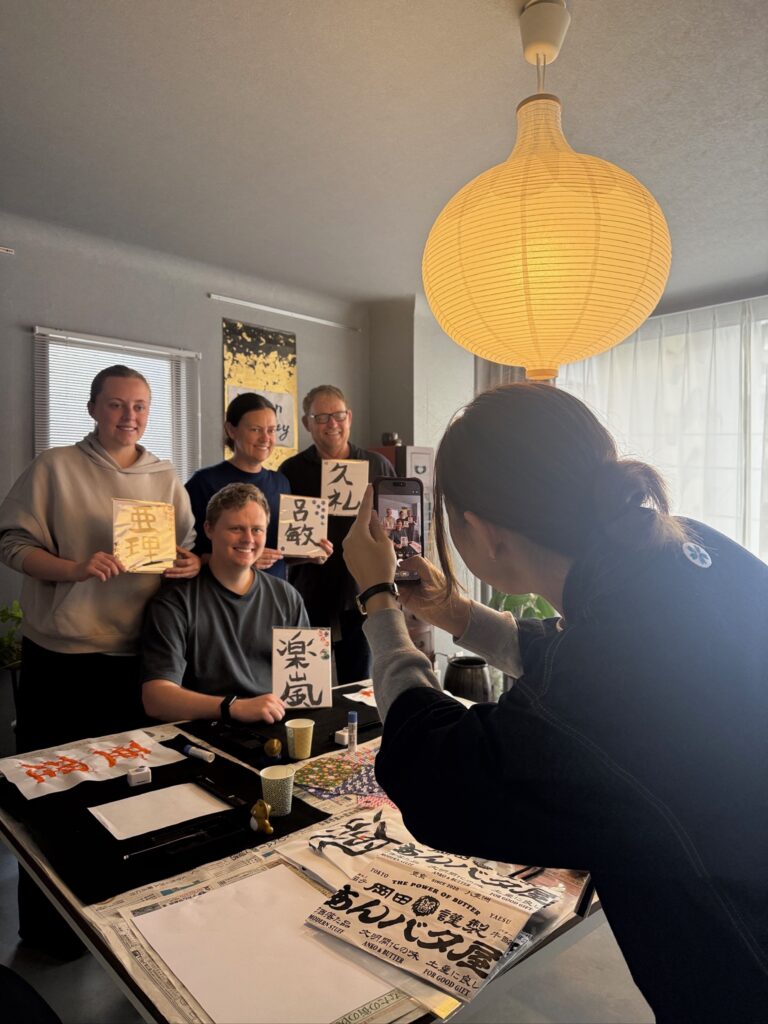
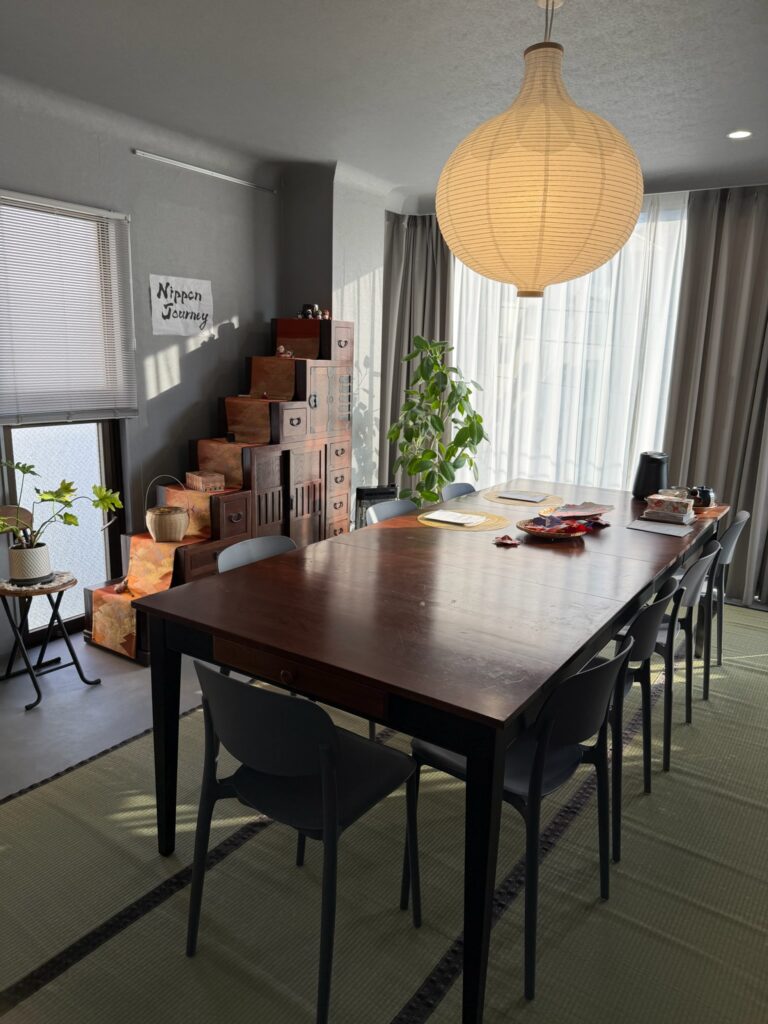
At Nippon Journey, we offer a Shodo experience designed especially for international visitors who want more than sightseeing.
The experience begins with a simple introduction to the history of Shodo and the Japanese writing system.
Because language can be a barrier, we use illustrated storytelling to explain the background clearly and gently, making it easy to understand even for first-time learners.
Next, participants practice basic brush techniques.
This step is not about doing it perfectly, but about getting used to the feeling of the brush, ink, and paper.
The heart of the experience comes next.
Each participant chooses their name or a word that is meaningful to them, and we help translate it into Kanji.
The selection is based on sound and meaning, similar to how ancient Japanese people once used Manyogana.
We carefully explain the meaning of each character so that participants can choose the one that truly resonates with them.
After deciding on the characters, participants create their final piece.
They can choose from several items, such as fans or other keepsakes, to write their calligraphy on.
To make the experience even more memorable, the finished calligraphy is turned into a sticker on the spot.
Many guests immediately place it on their phone case or suitcase, taking a piece of their experience with them wherever they go.
The experience lasts about 90 minutes and is designed to be calm, personal, and meaningful.
Rather than rushing through activities, we focus on creating a moment of connection — with Japanese culture, with history, and with oneself.
Our studio is located in central Hiroshima, within walking distance of major hotels and the Peace Memorial Park.
The interior is inspired by traditional Japanese aesthetics, and many guests tell us that the moment they enter the room, they feel a quiet sense of “Wow.”
Through Shodo, we hope visitors leave Hiroshima not only with knowledge, but with a warm memory and a smile.
This experience is for those who want to slow down, reflect, and create something truly personal during their journey in Japan.
\ Calligraphy Experience/